
Quick answer: Choosing the correct U-Step Neuro Walker comes down to three measurements. First, the user's height sets the frame: the Junior model fits 4'6" to 5'2", the Standard model fits 5'1" to 6'1", and the Tall model fits 6'0" to 6'6". Second, weight capacity: every standard-handlebar model supports up to 375 pounds, while the platform-arm models are rated to 300 pounds. Third, the neurological presentation decides the handle configuration — standard handlebars for most users, platform arms for weak upper-body or trunk control (common after a stroke or with a stooped posture), and a press-down lever for reduced hand strength. A Laser and Sound Cueing Module can be added to any model to address freezing of gait in Parkinson's disease. Measure before you order, and confirm the height range against the current specification sheet.
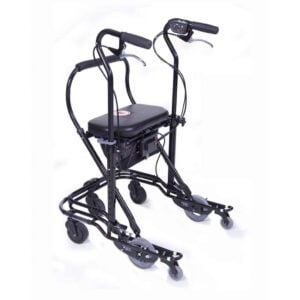
The U-Step Neuro Walker is not a general-purpose rollator, and it is not sized like one. It was engineered for people living with neurological conditions — Parkinson's disease, the effects of a stroke or traumatic brain injury, multiple sclerosis, ALS, ataxia, and other balance disorders — where a conventional walker often does more harm than good. Because the device is prescribed to the person rather than sold off a shelf, getting the fit right matters. A frame that is too tall forces a stooped, unstable posture. A frame that is too short does the same in the opposite direction. The wrong handle style can leave a user with a weak grip unable to release the brake safely.
This guide walks through the measurements you need, the models those measurements point to, and the clinical factors that determine handle style and accessories. If you are fitting a patient, a parent, or yourself, work through it in order.
Step 1: Take the measurements that actually drive the decision
Two numbers do most of the work: standing height and body weight. Height determines the model and handlebar length. Weight determines whether every configuration is available to you or whether the 300-pound platform models are ruled out.
- Standing height — measured in stocking feet, floor to the top of the head. This is the single most important input. The U-Step is sized in inch ranges, and the ranges overlap slightly at the boundaries, so a precise measurement prevents ordering the wrong frame.
- Body weight — every standard and press-down model is rated to 375 pounds. The platform-arm models are rated to 300 pounds because the arm troughs change the load path. If the user is over 300 pounds and needs platform arms, contact us before ordering so we can confirm the right build.
- Hand and grip strength — the U-Step uses a reverse-braking system: it will not roll until the user lightly squeezes a hand brake, and it stops the instant the brake is released. A user who cannot sustain that squeeze may need the press-down lever instead.
- Posture and upper-body control — a stooped posture, weak trunk, or limited ability to bear weight through the hands points toward platform arms rather than standard handlebars.
- Freezing of gait — if the user experiences freezing episodes (most often in Parkinson's disease), plan for the Laser and Sound Cueing Module. It attaches to any model.
Pro tip: Measure standing height at the time of day the walker will be used most. Posture and height can shift measurably between morning and evening for people with Parkinson's and other movement disorders.
Step 2: Match height to the base model
The U-Step Neuro Walker is built on three base sizes — Junior, Standard, and Tall — distinguished by frame height, handlebar height, and seat height. The Standard is the default and fits the widest range of adults. Junior and Tall exist for users at the ends of the height spectrum. The table below reflects the current In-Step Mobility specifications.
| Model | Fits height | Seat height | Weight capacity |
|---|---|---|---|
| Junior U-Step Neuro Walker | 4'6" – 5'2" (54"–62") | 19" | 375 lb |
| Standard U-Step Neuro Walker | 5'1" – 6'1" (61"–73") | 22" | 375 lb |
| Standard (Tall) | 6'0" – 6'6" (72"–78") | 22" | 375 lb |
If the user falls in an overlap zone — for example, right at 6'0" or 6'1" — order based on their build and posture, and confirm with us before purchase. The Tall configuration is also available as a set of tall handlebars that attach to a Standard base, which is useful when a household shares one walker across users of different heights.
Browse the base models here: Standard U-Step II, Small / Junior U-Step II, and Tall U-Step II. All U-Step models and accessories are gathered on our U-Step brand page.
Step 3: Choose the handle style based on the condition, not the height
Once height has narrowed the base, the neurological presentation decides the handles. This is where fitting the U-Step differs most from fitting an ordinary walker. There are three handle configurations, and each is built on the same stable U-shaped base.
Standard handlebars — the default
The Standard model with conventional hand brakes is the starting point for most users, including the majority of people with Parkinson's disease. Choose it when grip strength is adequate to squeeze and hold the brake, and when the user can bear weight through their hands and maintain a reasonably upright posture. See the Standard U-Step II Walking Stabilizer.
Platform arms — for weak upper body, weak trunk, or stooped posture
The Platform U-Step replaces the standard handlebars with forearm troughs. It is most often recommended for individuals who have had a stroke or brain injury, who have a stooped posture, or who have a weak upper body and trunk — situations where gripping and pressing down through the hands is not reliable. Because the arm platforms change the geometry, these models carry a 300-pound weight limit and fit a slightly narrower height band per configuration. Platform arms are available in Standard (fits 5'1"–5'9"), Tall (fits 5'8"–6'4"), and Junior builds. See the Platform U-Step II, or the arm platform attachment if you already own a compatible base.
Press-down lever — for reduced hand strength
The Press Down model replaces the squeeze brake on one side with a lever the user presses down to move. It is built for weak hand strength — when a user cannot sustain the grip the reverse-braking system requires. The lever is ordered for a specific side and is placed on the weaker hand: choose PDL for the left side or PDR for the right. It is available on Standard and Junior bases and retains the 375-pound capacity. See the Press Down U-Step II.
Real talk: The single most common fitting error we see is ordering standard handlebars for a user who cannot hold the brake, or platform arms for a user who has the grip strength to use standard handles and would rather. Match the handle to what the hands and trunk can actually do, not to what seems easiest on paper.
Step 4: Add cueing if freezing of gait is a factor
Freezing of gait — the sudden, temporary inability to step forward — is common in Parkinson's disease and is one of the reasons the U-Step exists. The Laser and Sound Cueing Module addresses it directly. Pressing the button projects a bright line on the floor in front of the user; stepping over that visual target helps break the freeze and restore a normal stride. An optional metronome adds an auditory beat, adjustable across roughly 15 speeds from about 59 to 130 beats per minute, to pace walking cadence.
The module attaches to any U-Step model and is offered with a red laser (the default) or a green laser, which some users find easier to see on certain floor surfaces and in brighter rooms. Add it to a new walker or retrofit an existing one: Laser + Sound Cueing Module for the U-Step II.
Pro tip: Not every Parkinson's user needs cueing on day one. If freezing is intermittent, the module can be added later — the mounting is designed for it — so there is no penalty for starting with the base walker and assessing.
Why the base design matters for every model
Whichever model you land on, the reason the U-Step works for neurological users is the same: the patented U-shaped base. Most of the walker's weight sits low in a solid welded frame, giving a low center of gravity, and the "U" surrounds the user to brace against falls in every direction rather than only from behind. The turning wheels sit toward the middle of the base rather than the rear, so the walker turns around in about 29 inches — compared to roughly 50 inches for most advanced rollators — and at about 23 inches wide it clears standard interior doorways. Rear safety wheels resist backward falls, and optional base weights can be added when a user needs even more stability.
Accessories worth deciding on up front
- Laser and Sound Cueing Module — for freezing of gait; red or green laser. Fits any model.
- Heavy-duty wire basket and tray — includes an integrated backrest and adds carrying capacity; fits any model.
- Base weights (pair) — Velcro to the base to increase stability for users who need it.
- Replacement parts — wheels, brakes, and hardware are stocked so a well-fitted walker stays in service. See U-Step walker parts.
Frequently Asked Questions
What size U-Step Neuro Walker do I need?
Match the model to standing height: Junior fits 4'6" to 5'2", Standard fits 5'1" to 6'1", and Tall fits 6'0" to 6'6". If you fall in an overlap zone at the boundary of two sizes, choose based on build and posture and confirm the fit before ordering.
What is the weight capacity of a U-Step walker?
The Standard, Tall, Junior, and Press Down models are each rated to 375 pounds. The Platform (arm-trough) models are rated to 300 pounds because the arm platforms change how load is carried through the frame.
Should I choose the Platform or the Press Down model?
Choose Platform arms when the user has a weak upper body or trunk, a stooped posture, or is recovering from a stroke or brain injury and cannot reliably bear weight through the hands. Choose the Press Down lever when the main limitation is hand and grip strength but posture and trunk control are adequate. The lever is placed on the weaker hand.
Does the U-Step help with Parkinson's freezing of gait?
Yes. The optional Laser and Sound Cueing Module projects a line on the floor to give the user a visual target to step over, which helps break a freezing episode, and an adjustable metronome can pace walking cadence. The module fits any U-Step model and can be added later if freezing develops or worsens.
Can accessories be added to a walker I already own?
In most cases, yes. Tall handlebars, platform arms, the press-down lever, the cueing module, the basket and tray, and base weights are all designed to attach to a compatible existing base. Match the accessory to your specific model and size, and contact us if you are unsure which build you have.
The short version
Measure standing height and weight, then let the condition guide the handles. Height picks Junior, Standard, or Tall. Weight confirms whether the 300-pound platform builds are on the table. Grip strength, trunk control, and posture decide between standard handlebars, platform arms, and the press-down lever. Freezing of gait adds the cueing module. Get those four decisions right and the walker fits the person, not the other way around. If you want a second set of eyes on a fit, send us the height, weight, and a note on the user's condition, and we will point you to the exact model.
— The HME Team